
At Gen Con, Dungeons & Dragons franchise head Dan Ayoub joined various D&D team members and stars connected with D&D to reveal future plans for the game and franchise. They announced more D&D for everyone, but not all of it’s for you.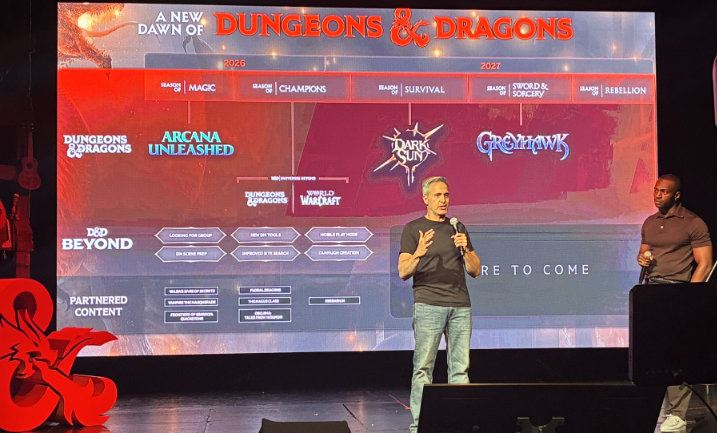
D&D Icons
Even though the D&D Icons program looks 40-some years back rather than ahead, it led the announcements. Surely, the presence of Joe Manganiello at the presentation vaulted his program to the top. Joe rates as one of the biggest stars who flaunt a passion for D&D. He serves as chief creative officer of the Icons initiative. The Icons initiative links upcoming, and mostly unspecified, D&D products to creative titans from D&D’s past.
The D&D Icons program starts with four creators :
- Luke Gygax, son of D&D co-creator Gary Gygax and, of his six children, the biggest contributor to their father’s D&D legacy.
- Margaret Weis and Tracy Hickman, authors of the Dragonlance Chronicles trilogy of novels, the fiction which introduced D&D’s Dragonlance setting to readers in 1984.
- R.A. Salvatore, creator of Drizzt Do’Urden, the Forgotten Realms setting’s most popular character. He has written more than 40 books set in the Realms.
If you needed to read those descriptions to identify any of the icons, then the program isn’t for you. Icons aims for the demographic of Dan Ayoub and Joe Manganiello, men who grew up reading Drizzt and Dragonlance books between D&D games. Guys in this generation—guys like me—grew up with every bit of popular culture aimed at us, so now, some of our peers feel confused and threatened when other demographics get attention. When Dan says D&D “lost its way,” and later brings these creators to stage, he hopes to excite gamers who feel puzzled because their 80s favorites seem sidelined. When Wizards of the Coast announced the third edition back in 1999, I watched Gary Gygax brought to the stage and I felt thrilled, so I understand the appeal of the icons. Gygax and the icons serve a similar purpose: They soothe long-time fans of D&D by showing them that the game still includes things they loved.
Despite the consulting contract that Gary signed in 1999, he just gave the third-edition team his blessing and wished them success. Perhaps the creators working as icons will have more input on the projects linked to their names, but except for the novels, newer designers will surely do the heavy lifting on the icons projects. That approach may create better releases. While the team that created the third edition stood on Dave and Gary’s shoulders, the new edition brought design innovations that the original creators could not have matched.
Oddly, the Icons project promises a return to settings that have all appeared recently in major D&D releases. Drizzt’s territory of the Icewind Dale rates as one of the most visited locations in fifth-edition products. Melf’s Guide to Greyhawk from Luke Gygax will appear in the wake of the Greyhawk coverage in the 2024 Dungeon Master’s Guide. The Dragonlance setting gained a hardcover release in 2022.
Universes Beyond
The D&D team announced Universes Beyond, a series of crossovers starting with one between World of Warcraft and D&D, and one between Star Wars and D&D.
Universes Beyond comes from the Magic the Gathering game. In 2025, the Final Fantasy set of Magic cards became the game’s highest-selling release, pushing the game’s Lord of the Rings and Avatar: The Last Airbender sets to second and third place. Such crossovers earn record sales by appealing to fans who don’t play Magic. The pairing works because so many collectors find trading cards irresistible even if they opt not to play the game.
Still, when fans of something like Final Fantasy collect the cards, many feel inspired to try playing Magic, and some become hooked. Hasbro CEO Chris Cocks called the crossover sets “probably the most successful new player adoption program that we’ve ever done.” Fat D&D game books lack the same collectable appeal as cards, so Dungeons & Dragons/Star Wars will never bring more than a fraction of the collectors attracted to a fan-favorite property crossed with Magic the Gathering. Still, D&D’s Universes Beyond crossovers aim to bring new players to D&D rather than to simply coax existing players to spend more.
Partnerships with outside studios
For existing fans of D&D, Wizards announced partnerships that will publish official content for Ravenloft, Eberron, and the Forgotten Realms, all written by outside studios.
The partners all boast experience making quality D&D content, and each brings an affinity for their chosen setting. The Ghostfire Gaming setting of Grim Hollow matches the dark horror tone of Ravenloft. Visionary Production & Design already produces Eberron books stewarded by the setting’s creator, Keith Baker. Starting with Hoard of the Dragon Queen in 2014, Kobold Press wrote the first two hardcover adventures released for fifth edition. Both featured the Forgotten Realms.
Adding so many setting-specific releases to D&D’s publishing schedule shows a daring change to the D&D’s team’s market strategy—a break from a lesson learned when D&D’s original publisher went to the brink of bankruptcy. In the 90s, TSR released a flood of settings and setting-specific products that split fans’ attention and spending. Fans of a setting tended to skip releases for as many as eight other settings, and so many products failed to recoup costs. Former D&D brand manager Jim Butler said, “TSR had too many product lines chasing too few customers.”
In the decades since, Wizards has avoided dividing customers with a flood of products that compete with each other. When they revisited a campaign setting, they published just a book or two for the setting, and they also avoided scheduling other releases that might battle for attention.
Now, the D&D team sees a customer base large enough for four or more settings to fight for fans’ budgets and time. “Players shouldn’t have to wait decades for D&D to return to a setting. We should be making it easier to adventure in those worlds,” D&D Executive Producer Greg Bilsland said. “The problem is, of course, we only have so many people on the D&D team and supporting all of our settings wasn’t feasible.”
Dark Sun
When I started playing D&D, the demons and occasional nudity in the advanced game flattered me by making me feel mature and by making playing seem like a delicious little rebellion. Now, with a new Dark Sun release scheduled for release as two books with a mature rating, I wonder how the rating will enhance the setting. The animated trailer revels in blood splatters and costumes that could fit in a catalog for fetish wear.
I suspect the D&D team opted for the mature rating for two reasons:
- The Heavy Metal style adds spice and contrasts with the other fifth-edition settings.
- The setting includes elements that now fit uncomfortably in a typical D&D game.
In early D&D, scenes where characters tortured their foes for information and slaughtered their foes’ babies seemed common. Now virtually all D&D games steer clear of such horrors and I welcome the change. The Dark Sun setting includes some of its own horrors that many gamers choose to avoid in a fun pastime. One example stands out. Dark Sun included slavery in the foundation of its world building. Chris S. Sims, one of the designers who worked on the setting for fourth edition, writes, “Slavery in Dark Sun isn’t like it is in the A series [of adventures], where it’s clearly villainy. In Dark Sun, it’s a cultural norm with a (spoiler) horrid, secret reason for keeping it. It can be an evil you fight, but presenting it as a cultural norm, baking it into some mechanics, implies it’s acceptable.”
D&D players enjoy battling evil, and many players see slavers as a good target for heroes. Other players find the subject of slavery too troubling for game sessions that should provide a fun escape. Either outlook is fine. The Dark Sun designers face the challenge of deciding how to accommodate the different perspectives. Perhaps, the mature rating helps.
Greyhawk: Crown of the Witch Queen
Of all the products announced for the coming year, Greyhawk: Crown of the Witch Queen seems like the one for me. Wizards touts the book as a full-length adventure, which suggests that the campaign starts at first level. The last campaign hardcover to start at level 1, Phandelver and Below: The Shattered Obelisk, released three years ago and revisited content from 2014. The upcoming adventure comes from the design team of Will Doyle, Stacey Allan, and Justice Arman. All three have worked on favorite adventures. The prospect of a new full-length campaign to play or run excites me.