
In 1976, after Dungeons & Dragons co-creator Gary Gygax, the most important person in roleplaying games was a Los Angeles woman named Lee Gold. She still contributes to the hobby and still runs a campaign using her Lands of Adventure (1983) game.
Lee who? And what happened to Gary’s co-designer Dave Arneson? Although Dave and his circle of Minneapolis gamers deserves the most credit for inventing roleplaying games, Dave’s passion centered on sailing ships in the age of Napoleon. He never matched Gary’s fervor or written output. In 1976, Dave would work briefly for TSR, but little came of it. See Basic and Advanced—Dave Arneson takes a job at TSR.
Meanwhile, D&D’s popularity exploded. Nothing else like the revolutionary game existed and it proved irresistible to most wargamers and fantasy fans. See 4 Pop-Culture Assumptions That Dungeons & Dragons Destroyed.
In 1975, Hilda and Owen Hannifen told their friend Lee Gold of a wonderful new game called Dungeons & Dragons. “Hilda had made up a dungeon and she ran it for us. So you see our first experience was with a female game master. It was a lot of fun.” Lee’s friends gave her a photocopy of the rules, but not before they watched her post a check to TSR for an official copy. “I started making up a dungeon—and told our local friends that they could start coming over and participating in D&D games that I’d be game mastering.”

Alarums & Excursions issue 2
Even before Internet message boards and blogs, science fiction and fantasy fans liked sounding off. So they published fanzines, or just zines. To publish, fans typed their thoughts, printed copies on a mimeograph or an employer’s photocopier, and then mailed to friends. “A zine may include essays, comments on previous issues, poems or songs, a writeup of a gameplaying session, artwork, and just about anything imaginable,” writes Lee. For efficiency, zine publishers started collaborating in amateur press associations, or APAs. These associations bundled collections of zines under a single cover to save on postage and to create publications matching the substance of a magazine.
Excitement in the new D&D game fueled so much discussion that it started to overwhelm the pages of the APA-L from the Los Angeles Science Fantasy Society. To meet surging interest, and to the let APA-L refocus on literature, Lee Gold started a new APA devoted to roleplaying games. She named it Alarums & Excursions after a phrase Shakespeare used to denote a confused uproar in stage directions. Plus, a name starting with ‘A’ would appear at the top of any list of APAs. Pronounce “Alarums” as alarms. The first issue debuted in June 1975 as the first periodical devoted entirely roleplaying games.
For a standard APA, an official collator collects fanzines and then mails the collections to the authors. “I didn’t want anything that minor,” Lee explains. “I also wanted subscribers, and the subscribers would support the contributors. It was something that had never been tried before. Therefore, I wanted to have something where there would be lots of subscribers and then contributors wouldn’t have to pay anything for postage. This was a whole new thing that had never been done before. It was my entirely new and brilliant, I hoped, idea.” This model allowed Alarums to reach a wider audience than a traditional APA. Hobby shops stocked issues of A&E alongside magazines. As A&E gained contributors, the page counts burgeoned from 30 to 150, when the limits of binding and shipping forced Lee to hold contributions for future issues.
The shabby state of D&D’s original rules inspired much discussion, and Lee’s Alarums & Excursions served as the hub of this network. “All the role players I know, when we looked a Gary Gygax’s game with its “% liar” and all its typos said, ‘this stuff needs tinkering.’ Ken St. Andre looked at it an wrote Tunnels & Trolls, and the people in Michigan wrote their thing, and the people at CalTech wrote their thing, and Steve Perrin wrote his thing. Everybody tinkered with D&D because it needed tinkering to be playable. The nice part about D&D was that it obviously needed player help. Well, obviously to all the players I knew.” (The people in Michigan likely refers to the Metro Detroit Gamers, who published the original tournament versions of the TSR modules S4 Lost Caverns of Tsojcanth and O1 The Gem and the Staff, and regularly ran conventions like Wintercon and Michicon. The thing from CalTech is the Warlock rules which came to influence D&D through J. Eric Holmes. For more on Warlock and Steve Perrin, see How D&D Got an Initiative System Rooted in California House Rules.)
The zines that Lee published in A&E became profoundly influential on the evolution of role playing games. Lee says, “I remember zines from Dave Hargrave giving tidbits of the Arduin Grimoire, Steve Perrin’s Perrin Conventions (which were the start of the system that later grew into Runequest), Ed Simbalist and Wilf Backhaus’s discussion of Chivalry & Sorcery, John T. Sapienza, Jr.’s discussion of various game systems, and other professional and semi-professional writers. I remember Mark Swanson’s ‘character traits,’ a way of individuating characters with minor bonuses and minuses. I remember a number of people (including myself) getting tapped to write games professionally because RPG publishers read their A&E zines.“ Other contributors included D&D Expert Set author Steve Marsh, third-edition D&D lead designer Jonathan Tweet, Vampire: The Masquerade designer Mark Rein-Hagen, fourth-edition D&D lead designer Rob Heinsoo, Paranoia and Star Wars roleplaying game designer Greg Costikyan, and more. Plus, a fellow named Gary Gygax contributed to issues 2, 8, and 15.

Alarums & Excursions issue 1
Soon though, Gary came to hate APAs like A&E. Partly, he seemed to see APAs as ringleaders for thieves, and not just the sort who—in Gary’s estimation—stole a ride on his coattales. Remember that Lee Gold started with a photocopy of the D&D rules. Early on, copies of D&D, especially outside of TSR’s reach in the Midwest, proved scarce. The $10 price of the original box struck many gamers as outrageous. In the first issues of Alarums & Excursions, some contributors argued that TSR’s profiteering justified Xerox copies of the D&D rules. Gary wrote a rebuttal and Lee told readers that Gary deserved to gain from his work and investment. Surely though, he remained incensed.
Eventually, all the discussion of D&D’s flaws and all the redesigns of the game wore on Gary’s pride in his creation. In issue 16 of The Dragon, he wrote, “APAs are generally beneath contempt, for they typify the lowest form of vanity press. There one finds pages and pages of banal chatter and inept writing from persons incapable of creating anything which is publishable elsewhere. Therefore, they pay money to tout their sophomoric ideas, criticize those who are able to write and design, and generally make themselves obnoxious.” For a rebuttal of Gary’s criticism, refer back to A&E’s list of contributors.
Meanwhile, Lee published A&E and began writing games. Much of her work showed an interest in history and particularly Japan, where she lived 4 months during A&E’s first year. Land of the Rising Sun (1980) extended the Chivalry & Sorcery system to Japan. Her game Lands of Adventure (1983) aimed for roleplaying in historical settings. Her other credits include GURPS Japan (1988) and Vikings (1989) for Rolemaster.
Men dominated the gaming community of the 70s, but Lee felt insulated from that culture because she came from science fiction fandom. “The SF fan experience was largely male when I entered in 1967, but it wasn’t male-dominated. SF fandom of the late 1960s had only a few women, but they were highly charismatic women—including women like Bjo Trimble—and they were not dominated by men. I entered the Los Angeles Science Fantasy Society as an editor and the leader of a sub-group that produced a fanzine, The Third Foundation.
 “This pattern of female equality also held true for the D&D play and roleplaying that took place in SF fandom—and that’s where I did my roleplaying. Not at hobby stores but at the LASFS and at science fiction conventions, usually with old friends or with people I’d met through A&E. A&E started through people who already knew one another through APA-L or through science fiction fannish connections.”
Meanwhile, the men in gaming tended to suppose that only men contributed to the hobby. Lee remembers visiting the Origins convention and spotting shirts for sale that identified the wearer as a “wargaming widow.” Why else would a woman attend a gaming convention?
After Lee finished writing Land of the Rising Sun for Fantasy Games Unlimited, she met publisher Scott Bizar at a local convention to sign the contract. She recalls discussing the game’s credits.
“Do you want to say this game is written by yourself and your husband Barry?” Bizar asked.
“No,” I said. “Barry didn’t write any bit of it. He did the indexing, and I gave him full credit for that. I wrote all of the game. Just say the game is by Lee Gold.”
“Most female writers say they wrote a game with their husbands,” said Bizar.
“I don’t care what other people do,” I said. “Just say the game is by Lee Gold.” And so Land of the Rising Sun came out as written by Lee Gold.
Her one personal encounter with Gary Gygax revealed a similar bias. Early on, Lee sent copies of A&E to TSR. After a couple of months, she received a phone call, which she recounts.
“This is Gary Gygax,” said the voice, “and I’d like to speak to Lee Gold.”
“I’m Lee Gold,” I said. “I gather you got the copies of A&E I sent you.”
“You’re a woman!” he said.
“That’s right,” I said, and I told him how much we all loved playing D&D and how grateful we were to him for writing it.
“You’re a woman,” he said. “I wrote some bad things about women wargamers once.”
“You don’t need to feel embarrassed,” I said. “I haven’t read them.”
“You’re a woman,” he said.
We didn’t seem to be getting anywhere, so I told him goodbye and hung up.
Despite her design credits, Alarums & Excursions rates as Lee Gold’s most stunning achievement. Since 1975, she has sent the APA monthly with only two lapses: one during her stay in Japan and a second scheduled for health reasons. Today though, many subscribers take their copies through email.
 Every D&D game has rolls important enough to grab everyone’s attention. Does the dragon’s breath weapon recharge? Did the inspirational speech win an ally? A die roll can spell the difference between victory or defeat, and sometimes between life and death. As a DM, you can spotlight these moments to heighten the drama and excitement.
 Instead, we add dice.
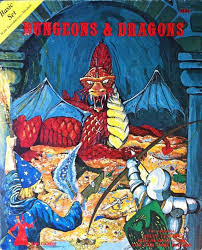 Starting with the original rule books plus the Blackmoor and Greyhawk supplements, Holmes made D&D comprehensible while keeping “the flavor and excitement of the original rules.” As much as he could, he reused wording from the original game. But J. Eric Holmes had learned to play D&D from the Caltech Warlock rules and he probably had seen The Perrin Conventions. That experience led him to pitch Warlock’s spell-point system to Gygax. We know how that turned out. Gary hated spell points. However, Holmes’s take on D&D included one West coast innovation: The character with the highest Dexterity struck first. Back then, monster stats lacked a number for Dexterity, so the rules explain, “If the Dungeon Master does not know the dexterity of an attacking monster, he rolls it on the spot.”
 Before you old grognards rush to the comments to correct my opening line, technically the original books lacked any way to decide who goes first. For that rule, co-creators Gary Gygax and Dave Arneson supposed gamers would refer to Gary’s earlier Chainmail miniatures rules. In practice, players rarely saw those old rules. The way to play D&D spread gamer-to-gamer from Dave and Gary’s local groups and from the conventions they attended. D&D campaigns originally ran by word-of-mouth and house rules.
 Chainmail lets players enact battles with toy soldiers typically representing 20 fighters. The rules suggest playing on a tabletop covered in sand sculpted into hills and valleys. In Chainmail each turn represents about a minute, long enough for infantry to charge through a volley of arrows and cut down a group of archers. A clash of arms might start and resolve in the same turn. At that scale, who strikes first typically amounts to who strikes from farthest away, so archers attack, then soldiers with polearms, and finally sword swingers. Beyond that, a high roll on a die settled who moved first.
 Using “feat,” a word for a stunt, as a game term for a character feature or talent bothers my wish for precise terminology. Back in the third-edition days, this word choice annoyed me to such an embarrassing degree that I griped about the misnomer on the Wizards of the Coast D&D boards. That post probably only exists on a backup tape labeled “GLEEMAX” in magic marker.
 Five years ago, I wrote the
  Compared to chalk, Magic Mouth offers more portentous way to deliver a message. Glyph of Warding adds a common magical trap. The spells weave useful magical effects into both the lore and the rules of the game. They give DMs ready-made tricks for their dungeons. Players enjoy recognizing these familiar bits of spellcraft mixed with the fantastic.
 I asked D&D enthusiasts to name the strangest quirks in the rules. This post lists some of the best answers. I skipped the part of D&D that most brazenly defies reality: The rules for damage and recovery. Those unrealistic hit points enable the games’ combat-intensive, dungeon-bashing style, so I count that absurdity as a feature. (See